
Want to identify emerging competitors before they gain traction? This guide shows how to use social media to monitor new players in your market and protect your position. Here are the key steps:
- Search relevant keywords and hashtags for your industry. Use platform search tools to find emerging brands.
- Monitor brand mentions and industry discussions with social listening tools like Hootsuite or Talkwalker.
- Analyze followers and influencer networks to uncover connections with emerging brands and trends.
- Use analytics tools like Social Blade or SEMrush to detect competitor growth patterns.
- Implement continuous monitoring by setting up alerts and watchlists.
Why act now? 85% of companies already use social media to gather competitive insights, and the social analytics market continues to grow rapidly. Identifying emerging competitors helps you adjust strategies and anticipate trends before they hit. Let’s get into it.
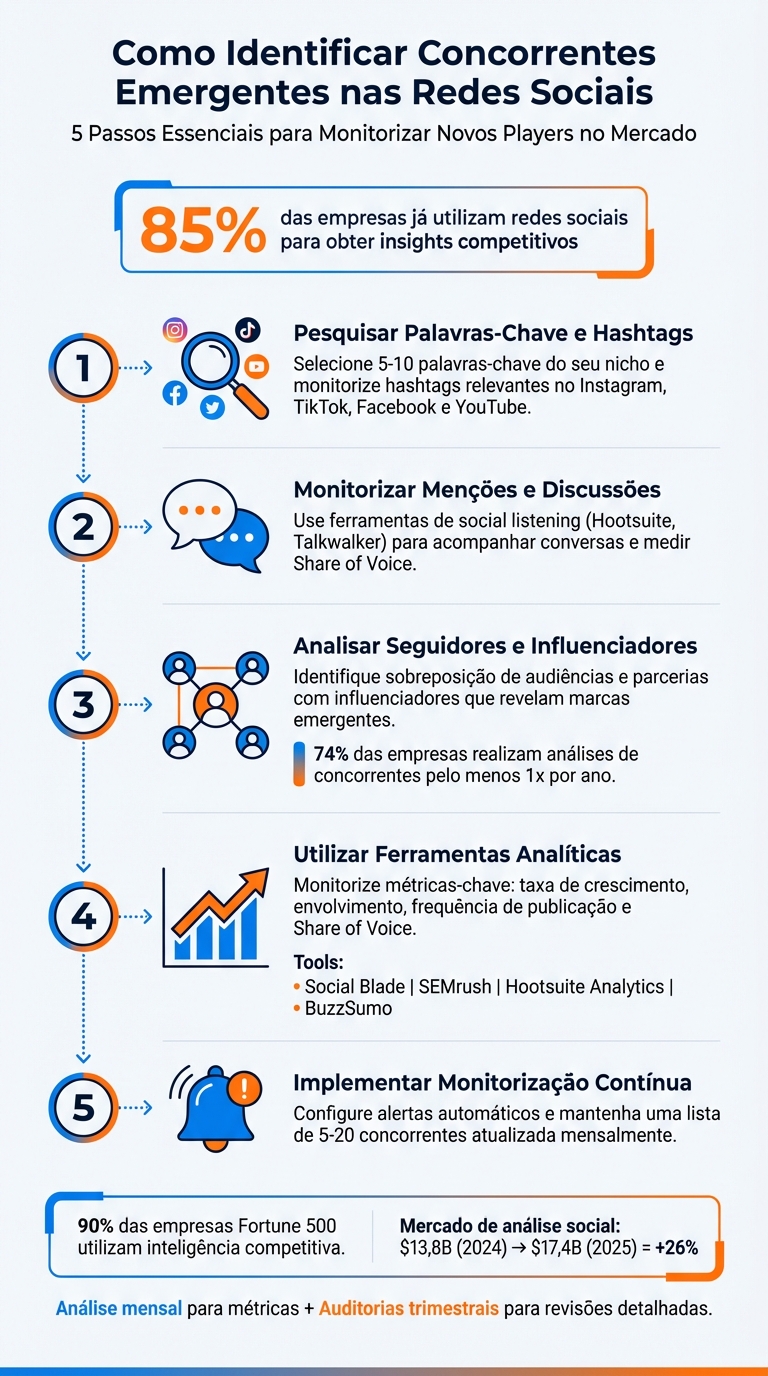
5 Steps to Identify Emerging Competitors on Social Media
Step 1: Research Industry Keywords and Niche Hashtags
Using Social Media Search Tools
Platforms like Instagram, Facebook, TikTok, and YouTube offer powerful search tools for identifying emerging brands. Start by selecting 5 to 10 keywords that best represent your niche or product. For example, if you work in sustainable cosmetics, terms like “natural skincare”, “vegan beauty”, or “organic skin care” are strong starting points.
On Facebook, apply the “Pages” filter after entering a keyword to differentiate brands from personal profiles or groups. On YouTube, try replacing a word with an underscore (“_”) in the search bar — this trick surfaces long-tail keyword suggestions related to your industry.
Once you’ve gathered relevant keywords, the next step is to explore the hashtags associated with them.
Monitoring Niche Hashtags
Hashtags are an excellent way to identify accounts that use them frequently, pointing to potential competitors or emerging brands. On Instagram and TikTok, search niche-specific hashtags and see which appear in featured posts or are used most consistently.
Also analyze the profiles of established competitors. Look at captions, bios, and even image alt text to discover the keywords they use to describe their niche. Pay attention to high-engagement posts and explore platform-suggested related hashtags — these can reveal niche terms you may not have considered.
sbb-itb-b3ef44f
How to Monitor Your Competitors’ Social Media 🔍
Step 2: Monitor Brand Mentions and Industry Conversations
Once you’ve identified keywords and hashtags, it’s essential to track industry conversations to understand competitor movements. This surveillance helps detect new competitors gaining traction with your target audience.
Using Social Listening Tools
Social listening tools are ideal for monitoring multiple online sources simultaneously. Platforms like Hootsuite or Sprout Social let you follow websites, blogs, forums, and social networks — helping you identify who’s talking about your brand and your industry.
Set up alerts for your brand name and relevant keywords to capture mentions of new competitors as soon as they appear. The “Share of Voice” metric is useful for measuring what proportion of online conversations your brand dominates compared to other players. Sentiment analysis can also reveal market areas where competitors are gaining ground, especially by solving problems your brand hasn’t addressed yet.
“Talkwalker helps our brand monitor trending topics and mentions across the web. Our social media team is able to quickly and seamlessly pull reports, look at dashboards, and keep informed.” – Jacqueline M., Social Media Marketing Manager, Grand Canyon Education, Inc.
Exploring Comments and Engagement Patterns
To complement automated monitoring, manual comment analysis provides deeper insights. Comment sections on your posts and competitors’ posts are a goldmine for identifying new players. When users recommend alternative brands, that’s a clear signal that new competitors are emerging.
Focus not just on the volume of comments, but on the quality of interactions. A small brand with a high engagement rate relative to follower count may signal an engaged community and a potential market disruptor.
Also pay attention to how quickly brands respond to comments. Emerging competitors often stand out through fast, effective customer interactions. Analyze comments that reveal frustration with your brand or direct competitors — these gaps are frequently exploited by new entrants to gain market share.
Step 3: Analyze Followers and Influencer Networks
After monitoring mentions and industry conversations, the next step is a deeper analysis of follower and influencer networks. This process helps identify emerging brands that may be competing for your audience’s attention.
Did you know that 74% of companies conduct competitor analysis at least once a year? And 90% of Fortune 500 companies use competitive intelligence to maintain their market position. Companies that invest heavily in customer analytics are 23 times more likely to outperform competitors in new customer acquisition.
Analyzing Follower Overlap
One effective way to understand your audience’s behavior is through shared follower analysis. This technique identifies other brands your audience also follows. Tools like Facebook Audience Insights or Twitter Analytics are useful for uncovering these connections.
On Twitter, for example, you can audit your “Top Followers” — your most active followers. By analyzing the accounts they follow, you can identify emerging brands that may not yet be on your radar. On Facebook, the “Liked Pages” feature offers insight into shared interests between your audience and competitors’ audiences.
Another area to explore is aspirational competitors — brands your audience follows for inspiration, even if they’re not direct competitors. These accounts may reflect shifts in consumer preferences. Tools like Talkwalker can help identify behavioral patterns and audience overlaps through advanced analytics.
Studying Influencer Connections
Influencers play a crucial role in connecting brands and audiences. By monitoring their partnerships and mentions, you can identify which emerging brands are gaining traction in your niche. Set up alerts for relevant industry keywords — whenever an influencer mentions an unfamiliar brand, add it to your watchlist.
But don’t just focus on follower count. Evaluate real influence. Tools like Klear help analyze which areas an influencer has the most authority in. If an influencer starts promoting a new brand within a sub-topic of your industry, that’s a signal the brand may be emerging as a specialist competitor.
Another useful strategy is using Keyhole to search niche-specific hashtags — this helps identify “top reference accounts”, the ones leading conversations about other brands. Monitor strategic influencer partnerships through social listening tools — when influencers collaborate with brands in your industry, those brands deserve attention.
“Understanding how your audience engages with competitor content provides a good starting point for your own content strategy.” – Christina Newberry, Social Media Writer, Hootsuite
Step 4: Use Analytics Tools to Detect Growth Patterns
After analyzing followers and influencers, the next step is measuring performance with analytics tools. These platforms turn raw numbers into actionable intelligence, helping you identify brands on the rise.
Tools for Competitor Analysis
Hootsuite Analytics lets you track up to 20 competitors simultaneously, providing data on follower growth, average engagement rates, posting frequency, and content performance across Facebook, Instagram, and X. Social Blade, a free tool, is ideal for monitoring follower growth on X, YouTube, and Twitch.
SEMrush Social Tracker provides information on competitors’ audience size, activity, and engagement rates. BuzzSumo analyzes Facebook performance by post type, length, and timing. For Instagram and TikTok, Not Just Analytics stands out by monitoring growth, hashtags, and engagement rates.
“A great advantage has been its competitive analysis tool, which has helped us create better and more detailed marketing strategies.” – Alejandra Perozo, Director, Brand Communications & Development Marketing, Eano Home Renovation
Brandwatch focuses on the “Social Share of Voice” metric, which measures a brand’s presence in online conversations compared to competitors — helping identify brands gaining ground in industry discussions.
Monitoring Key Growth Metrics
Beyond choosing the right tools, it’s essential to analyze the metrics that reflect real competitor growth. Follower growth rate is a clear indicator of how quickly a brand is gaining market relevance. For example, an account with 5,000 followers growing 20% per month may represent a greater threat than a stagnant account with 50,000 followers.
Engagement rate (likes, comments, shares, and saves relative to follower count) shows whether content is capturing audience attention. Accounts with high engagement rates, even with smaller followings, may be emerging as strong competitors. Posting frequency indicates the level of effort and consistency in a social media strategy.
| Metric | What It Reveals About Competitors |
|---|---|
| Audience Growth Rate | Shows how quickly a competitor is gaining traction. |
| Engagement Rate | Measures how effectively content connects with the audience. |
| Posting Frequency | Reflects investment and consistency in social strategy. |
| Share of Voice | Evaluates a brand’s presence in industry conversations. |
“When your competitors have impressive metrics, it’s essential to understand what they are doing well to build a better social media strategy.” – Meagan Williamson, Pinterest marketing expert and business coach
Pay attention to unexpected spikes in growth or engagement rates. Investigate the posts or campaigns that caused those increases to uncover relevant trends. Always compare results against industry averages to assess whether competitors are genuinely standing out.
Step 5: Set Up Continuous Monitoring Systems
After identifying growth patterns, it’s essential to implement automated systems that regularly track competitors. Continuous monitoring helps detect potential threats before they become problems and identify opportunities at the right moment.
Setting Up Alerts and Notifications
Modern tools allow you to configure real-time alerts to monitor competitor brand mentions across social media, blogs, forums, and news sites. You can use boolean operators to create “Saved Searches” that filter relevant information. Set up alerts to identify sudden spikes in a competitor’s engagement rate or shifts in public sentiment toward them.
With AI assistance, it’s possible to detect mentions across multiple formats — text, images, video, and even audio — through technologies like logo recognition. Tools like Talkwalker can monitor over 150 million websites and 30+ social platforms across 239 countries. AI models like Blue Silk™ AI can reportedly reduce time spent on social listening research by 40% weekly.
“Talkwalker helps our brand monitor trending topics and mentions across the web. Our social media team is able to quickly and seamlessly pull reports, look at dashboards, and keep informed.” – Jacqueline M., Social Media Marketing Manager, Grand Canyon Education, Inc.
Set up alerts for high-engagement content formats like Reels or Carousels to identify trends gaining traction. Create notifications for niche or brand-specific hashtags used by competitors, especially during new campaign or contest launches.
Building a Competitor Watchlist
Maintain an organized list of 5 to 20 key competitors. Start by identifying their usernames and adding them to a dedicated list.
Include both direct competitors (offering similar products or services) and indirect ones (premium or budget alternatives) for a complete market picture. Track these competitors across multiple platforms — Facebook, Instagram, X, LinkedIn, and TikTok — as strategies and results can vary significantly between networks. If you’re unsure which competitors to monitor, use industry benchmarking tools to compare your performance against market averages and identify niche leaders.
Update this list regularly — monthly, quarterly, or at least every six months — to include new competitors that emerge. The data collected can fuel SWOT analyses (Strengths, Weaknesses, Opportunities, Threats) to guide your marketing plan. Automate the collection of metrics like posting frequency, average engagement rates, and audience growth to save time and ensure accuracy.
Conclusion
Identifying emerging competitors on social media is no longer optional — it’s a strategic necessity for brands that want to stay relevant. The five steps in this guide — from keyword and hashtag research to implementing continuous monitoring systems — offer a practical roadmap for anticipating risks and seizing opportunities.
The numbers are clear: 85% of companies already use social media as a primary source of business intelligence, and the global social analytics market is projected to grow from $13.8 billion in 2024 to $17.4 billion in 2025 — a 26% increase in a single year. Competitors are capturing both consumer attention and investment. Identifying those moves early lets you sharpen your value proposition and redirect resources toward more effective strategies.
Turning data into action requires consistent analysis and well-grounded decisions. Partnering with a specialist agency like Cooprativa can be a real advantage. Cooprativa combines social media management, advanced social listening tools, and digital performance analysis to help brands outperform the competition — turning competitive monitoring into a genuine growth engine.
Set a consistent analysis rhythm — monthly for key metrics and quarterly for deeper audits — and keep your competitor list current. Knowing what others do well is an essential step toward building a more effective social media strategy. The first to act wins the advantage.
FAQs
How can I identify new brands in my industry through social media hashtags?
To discover new brands in your industry, start by monitoring the most relevant hashtags for your target audience and market. Social media analytics tools are great allies for identifying which hashtags are gaining traction and generating the most interaction. Tracking these hashtags helps detect emerging trends and find brands that are growing, even if they’re not yet widely known.
Another effective strategy is using social listening tools. These allow you to analyze mentions and sentiment around hashtags, helping identify rising brands capturing audience attention. Beyond revealing new competitors, this process provides valuable insight into the type of content attracting your audience — so you can adjust your marketing strategies accordingly.
By combining monitoring and analysis, you’ll be better positioned to stand out and stay competitive.
What are the best tools for monitoring competitors on social media?
If you want to stay ahead in the market, social listening tools can be your greatest asset. These tools help track what’s being said about your competitors, detect emerging trends, and understand general sentiment around rival brands — helping you identify both opportunities and potential threats.
There are many options available offering detailed analytics and real-time tracking. The right tool depends on your specific business needs and the depth of analysis you’re looking for.
How can follower analysis help identify new competitors on social media?
Follower analysis is an excellent way to detect competitors emerging in your market. By observing profiles that are growing rapidly, increasing engagement, and capturing your target audience’s attention, you can identify brands gaining strength in the digital space.
This information not only reveals important trends but also highlights strategies that are working — and allows you to anticipate competitors’ next moves, helping you maintain a strong market position.
Related Blog Posts
Let’s Get Started
Tell us about your project and we’ll get back to you within 24 hours