Scaling social media budgets without compromising ROAS requires a careful, data-driven approach. Sudden changes can destabilize the algorithm and reduce campaign effectiveness. To avoid this, follow these practices:
- Gradual increases: Raise the budget by 10% to 20% every 3-5 days.
- Set clear goals: Calculate your break-even ROAS and establish measurable targets.
- Identify top-performing campaigns: Prioritize the 20% that consistently deliver the best results.
- Precise targeting: Expand saturated audiences and optimize lookalike audiences.
- Effective creatives: Test variations before scaling and refresh saturated ads.
- Constant monitoring: Track metrics like ROAS, CPA, and frequency for quick adjustments.
Real-world example: One advertiser using lookalike audiences achieved a ROAS of 14.68:1, but saw it drop to 6:1 when the audience became saturated — reinforcing the importance of continuous adjustments.
By following these strategies, you can double your investment in 4-8 weeks without hurting results.
How to Structure and Scale Facebook Ads Campaigns in 2026 (In Practice)
sbb-itb-b3ef44f
What Is ROAS and Why It Matters
ROAS Benchmarks by Campaign Type and Industry on Social Media
ROAS (Return on Ad Spend) measures the revenue generated for every dollar invested in advertising, helping you make decisions based on concrete data. The formula is simple: ROAS = Revenue Generated / Ad Spend. For example, if a campaign generates $5,000 in sales from a $1,000 investment, the ROAS is 5:1.
“Your Facebook ad budget is not arbitrary. It’s a direct calculation based on your profit margins, revenue goals, and acquisition costs. Get it wrong and you’ll either under-invest… or overspend.”
- Bixente, co-founder of Trendtrack.
However, ROAS alone doesn’t give you the full picture. It’s essential to calculate your break-even point — the minimum return needed to cover costs without generating profit or loss. The formula is: 1 ÷ Profit Margin. For example, a brand with a 67% margin has a break-even ROAS of 1.49:1, meaning a ROAS of 2.0:1 is already profitable.
How to Calculate ROAS
The basic ROAS calculation divides total revenue by ad spend. However, many professionals are now adopting POAS (Profit on Ad Spend), which measures gross profit instead of total revenue: POAS = Gross Profit / Ad Spend.
To calculate how much you need to invest to hit a specific target, use this reverse formula: Desired Revenue ÷ Realistic ROAS = Required Investment. For example, to reach $150,000 in revenue with a ROAS of 3.0:1, you’ll need to invest $50,000.
During the testing phase, aim to invest between 1.5x and 2x your break-even ROAS. When scaling aggressively, target between 2x and 3x that value.
With your calculations in hand, it’s essential to compare your results against benchmarks for each campaign type to adjust your strategy accordingly.
ROAS Benchmarks by Campaign Type
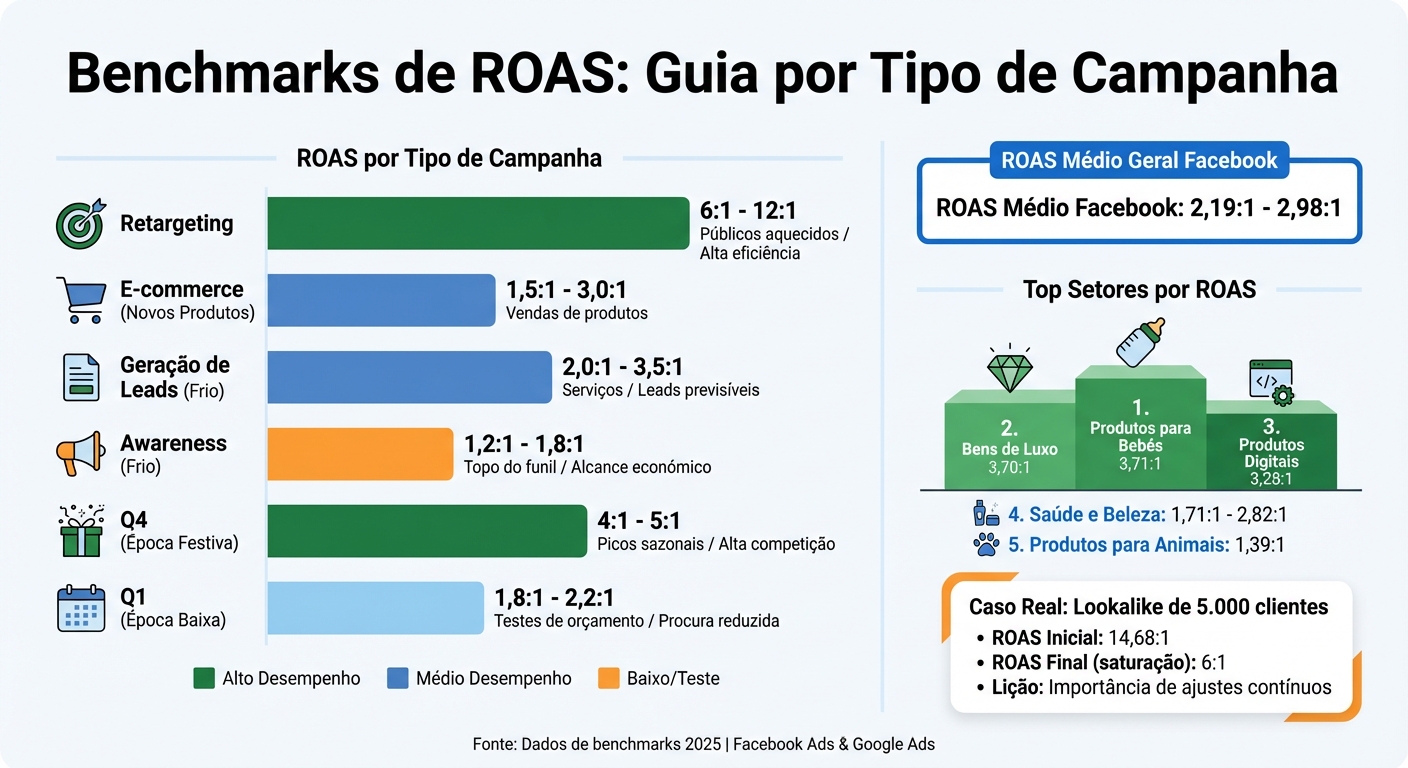
ROAS benchmarks vary significantly depending on campaign type and industry. For Facebook ads, the general average sits between 2.19:1 and 2.98:1. However, there are meaningful differences across campaign types.
Retargeting campaigns stand out with ROAS between 6:1 and 12:1, as they target audiences that have already shown interest. Awareness campaigns for cold audiences register between 1.2:1 and 1.8:1, but deliver greater reach at a lower cost.
| Campaign Type | Average ROAS | Best Application |
|---|---|---|
| Retargeting | 6:1 – 12:1 | Warm audiences / High efficiency |
| E-commerce (New Products) | 1.5:1 – 3.0:1 | Product sales |
| Lead Generation (Cold) | 2.0:1 – 3.5:1 | Services / Predictable leads |
| Awareness (Cold) | 1.2:1 – 1.8:1 | Top of funnel / Cost-efficient reach |
| Q4 (Holiday Season) | 4:1 – 5:1 | Seasonal peaks / High competition |
| Q1 (Off-Season) | 1.8:1 – 2.2:1 | Budget testing / Reduced demand |
By industry, digital products lead with an average ROAS of 3.28:1, followed by baby products (3.71:1) and luxury goods (3.70:1). Sectors like health and beauty show values between 1.71:1 and 2.82:1, while pet products register just 1.39:1.
A notable example: in March 2025, an advertiser using lookalike audiences based on a list of 5,000 customers achieved an impressive ROAS of 14.68:1. However, this dropped to 6:1 in the final week of the month — demonstrating the volatility of high-performance strategies.
Establish Performance Baselines Before Scaling
Before thinking about scaling, it’s essential to document the current performance of each campaign. Metrics like ROAS, CPA, and conversion rates must be carefully recorded. Without this data, it’s impossible to determine whether a campaign has room to grow or has already hit its efficiency ceiling.
Another critical step is ensuring technical stability. Confirm your tracking pixel is functioning correctly and verify that campaigns have exited the “learning phase.” This process typically requires 50 conversions per ad set within 7 days. Scaling before achieving this stability can restart the algorithm and compromise results. These steps create a solid foundation for setting clear goals and identifying where growth is possible.
Set Clear Goals and ROAS Targets for Each Campaign
Each campaign should have specific, well-defined objectives. The SMART methodology (Specific, Measurable, Achievable, Relevant, Time-bound) is an excellent framework for setting concrete targets — such as reaching a specific lead volume or monthly revenue goal. Instead of something vague like “increase sales,” define something like: “Generate $50,000 with ROAS ≥3:1 by end of quarter.”
To help with planning, factor in the break-even ROAS (1 ÷ Profit Margin), which indicates the minimum return needed to cover costs. During the testing phase, aim for between 1.5x and 2x that value. In a more aggressive scaling phase, target between 2x and 3x.
Want to calculate the required investment? Use this simple formula:
Desired Revenue ÷ Realistic ROAS = Required Investment.
For example, to generate $75,000 with a ROAS of 2.5:1, you’ll need to invest $30,000.
Identify Campaigns Ready to Scale
With clear objectives in place, the next step is identifying which campaigns have the most potential for growth. The 80/20 rule is highly useful here: focus on the 20% of campaigns that consistently deliver the best results — these are your prime scaling candidates.
Another factor to consider is “growth headroom.” If impression frequency exceeds 3 without a proportional increase in impressions, that’s a sign the audience is saturated. In that case, expand the audience before increasing the budget. Also ensure creatives have proven effective — scaling a campaign won’t fix creative problems.
Finally, monitor your landing page conversion rate. If traffic increases but the page isn’t converting, overall campaign effectiveness will suffer.
How to Scale Budgets Without Losing Efficiency
Once you’ve established a solid foundation, it’s time to increase investment carefully — ensuring the algorithm doesn’t get destabilized. Three key pillars are essential for safe scaling: gradual budget increments, continuous audience targeting adjustments, and ongoing creative optimization. Let’s explore each in depth.
Increase Budgets in Small Steps
The primary rule is simple: never increase the budget by more than 20% at once. An increase of 10% to 20%, applied every few days, is ideal — depending on whether you need balance or aggression.
“Many advertisers fail because they double or triple budgets overnight. Facebook’s algorithm gets disrupted and the ad set restarts the learning phase.”
– Lio Fung, China Business Dev, Ecom Parkour Ltd.
There are two ways to scale: vertically, by increasing the budget on a high-performing ad, or horizontally, by duplicating winning ads to reach new audiences or markets. When spend exceeds $1,000/day, it can be helpful to configure automatic rules in Ads Manager to adjust the budget if ROAS falls below the profitability threshold.
After adjusting budgets, the next step is ensuring audience targeting is performing efficiently.
Refine Audience Targeting
As budgets increase, targeting becomes essential for maintaining performance. Small audiences can saturate quickly as they scale. If frequency exceeds 3.0 and CTR (Click-Through Rate) starts dropping, it’s time to expand targeting. An effective approach is to start with 1% lookalike audiences and, as they saturate, gradually expand to 3%, 5%, or even 10%.
A practical example: furniture brand Nathan James used advanced targeting tools in 2025 to create more precise lookalikes. By excluding existing customers and leveraging commerce data, the brand attracted over 500 new customers, achieving a ROAS of 5.6:1 and reducing acquisition costs by 52%. Fashion brand Mac Duggal expanded its retargeting audience 2.3x while maintaining a consistent ROAS of 2:1.
For accounts generating 50+ conversions per week, consider removing interest and demographic restrictions — allowing the algorithm to find more cost-efficient conversions. Also keep audience overlap below 20–30% to avoid internal competition that could drive up CPMs and reduce ROAS.
With targeting refined, the focus should shift to creatives to maximize results.
Test and Improve Creatives
Scaling a budget can amplify creative problems. That’s why creative optimization is crucial to avoid waste. Before any budget increase, test 3 to 5 ad variations — changing elements like headlines, images, or CTAs. Only scale once an ad exits the learning phase. A good practice is to allocate 80% of the budget to proven creatives and 20% to testing new ideas.
“Scaling doesn’t fix weak creatives. If you run too many variations, it becomes hard to know what’s working.”
– Ansherina Opena, Digital Marketing Expert
For campaigns spending over $1,000/day, it’s advisable to update creatives weekly to maintain performance. Firebelly Tea tested new campaign formats and discovered that customers acquired through those formats were twice as likely to make a repeat purchase — reducing acquisition costs by over 50%. When testing, focus on one variable at a time — for example, change only the headline while keeping the same image — to identify what truly improves performance.
Advanced Methods to Protect ROAS During Scaling
Once you’ve built a solid scaling foundation, it’s time to explore more advanced strategies that help protect your ROAS as budgets grow. These include automated bidding with ROAS targets, attribution models for informed decisions, and a clear focus on bottom-of-funnel campaigns.
Use Automated Bidding with ROAS Targets
When scaling, it makes sense to shift from manual to automated bidding. Tools like “Target ROAS” on Google or “Value Optimization” and “ROAS Goal” on Meta are designed to maximize returns. These platforms prioritize showing ads when valuable conversions are most likely — avoiding unnecessary spend.
To adjust ROAS targets without destabilizing the algorithm, increase goals in small increments — typically 10–15%. Products with lower average order values may benefit from “Cost Caps” to control spend per result, while more complex catalogs can use “ROAS Goal” for greater precision. Also set up automatic rules that reduce budget if ROAS falls below your defined profitability threshold. By combining automated bidding with precise data, budget decisions become far more effective.
Apply Attribution Models to Budget Decisions
Attribution models are essential tools for identifying the touchpoints that actually generate conversions. They help you avoid cutting top-of-funnel campaigns that, while showing a lower initial ROAS, feed the success of mid-term remarketing campaigns. Remarketing campaigns frequently achieve ROAS between 6:1 and 12:1, while cold awareness campaigns typically land between 1.2:1 and 1.8:1. Cutting the top of the funnel can hurt overall performance.
For larger audiences, consider extending the attribution window — for example, from 1 to 7 days — to better capture the full customer journey. Complement platform data with post-purchase surveys to gain qualitative insights that pixels may not capture.
Focus on Bottom-of-Funnel Campaigns
Remarketing and conversion campaigns tend to deliver the highest ROAS, making them ideal to prioritize during scaling. Build specific campaigns for warm audiences — product page visitors, cart abandoners, and video viewers — using highly relevant messaging.
To avoid waste, exclude existing customers from prospecting campaigns — these can represent up to 40% of audiences but are already in the retention phase. By concentrating resources on audiences most likely to convert, ROI increases. Scale these campaigns gradually in increments of up to 20% every 3–5 days, and monitor ad frequency. Values above 3.0 may indicate saturation — a signal it’s time to refresh creatives.
Monitor Performance and Adjust to Market Changes
To scale budgets without losing efficiency, it’s essential to track the most important metrics daily. Set up daily dashboards to monitor indicators like ROAS, Cost per Acquisition (CPA), and frequency. This helps identify problems quickly before they escalate. You can also use automated rules to increase investment in campaigns performing well.
Seasonality is another important factor, as it directly affects metrics like ROAS and CPMs. During Q4, ROAS can reach 4:1 to 5:1 — but CPMs also rise due to increased competition. In Q1, ROAS tends to drop to 1.8:1–2.2:1, reflecting lower demand. During off-peak periods with CPMs 20–40% lower, scale aggressively and test new audiences. During peak demand, focus on maintaining efficiency in winning campaigns rather than expanding.
Another critical point is managing audience fatigue. When frequency exceeds 3, CTR typically drops and CPA rises — signaling it’s time to refresh creatives. For high-volume campaigns, consider updating ads weekly to avoid saturation. Also monitor competitor activity. An increase in competitor ad volume can signal greater auction pressure, resulting in higher CPMs.
Finally, go beyond traditional ROAS and pay attention to POAS (Profit on Ad Spend). This metric — which calculates gross profit relative to ad investment — offers a more complete picture. A high ROAS can be misleading if you don’t account for costs like production, shipping, and fees. POAS helps ensure that scaling is generating real profit, not just apparent revenue.
| Period / Season | Typical ROAS | CPM Trend | Recommended Strategy |
|---|---|---|---|
| Q4 (Holiday Season) | 4:1 – 5:1 | Sharp increase | Focus on efficiency, maintain winners |
| Q1 (Off-Season) | 1.8:1 – 2.2:1 | Low / Soft | Test budgets and build baselines |
| Off-Peak | Variable | 20-40% lower | Scale aggressively and expand |
Conclusion
Scaling budgets without compromising ROAS requires a structured, consistent approach. The main rule? Make gradual budget adjustments to prevent the algorithm from restarting its learning phase — which can seriously hurt results.
Monitor key metrics like frequency, CTR, and CPA daily. This helps identify signs of fatigue or saturation before ROAS starts to drop. Use automated rules to adjust or pause campaigns when indicators exceed profitability thresholds — these rules act as a safety net, especially during more intensive scaling phases.
This careful strategy allows you to maintain stability even when increasing budgets more aggressively.
“Scaling is not just about increasing budgets. It’s about finding what works, optimizing the right levers, and extracting maximum revenue without killing your ROAS.”
- Shifa Islam, Performance Marketer, Marketing Lab
Remember: scaling doesn’t mean just spending more — it means investing smarter. Combine vertical and horizontal scaling techniques to avoid saturation. Keep creatives fresh, run continuous tests, and base every decision on concrete data — never assumptions. Done right, you can double your investment in 4 to 8 weeks while maintaining or even improving your return on ad spend.
FAQs
How do I know if a campaign is ready to scale without hurting results?
Before deciding to scale a campaign, it’s crucial to evaluate performance metrics — particularly ROAS (Return on Ad Spend). The campaign should be delivering consistent results and meeting or exceeding your previously established goals.
When moving forward with scaling, increase the budget gradually — between 10% and 30% every 3 to 5 days. Throughout this process, closely monitor the impact these changes have on your metrics. If you notice a ROAS drop or it falls below your acceptable threshold, adjust strategy before making further increases. This method ensures controlled, efficient growth while keeping results on track.
What’s the difference between ROAS and POAS, and how do I know which to use?
ROAS (Return on Ad Spend) evaluates campaign effectiveness by comparing sales revenue generated to ad investment. POAS (Profit on Ad Spend) goes deeper — factoring in not just sales but also operational costs and profit margins to calculate the net profit generated by campaigns.
If you simply want to measure overall campaign performance, ROAS may be sufficient. But to understand real profitability and make more strategic decisions — especially when scaling budgets — POAS is the more reliable metric.
How do I identify audience saturation and what should I do about it?
When an audience starts to saturate, clear signals emerge: drop in engagement, rising cost per acquisition (CPA), and declining conversion rate. And the most frustrating part? This can happen even in well-optimized campaigns. The issue is that when users are repeatedly exposed to the same ads, they lose interest — resulting in lower ROAS.
Here are practical solutions:
- Expand your audience: Try creating lookalike audiences based on your most engaged customers. Another option is exploring new interests or demographics that haven’t been targeted yet.
- Refresh creatives: Alternate between different formats and messages to combat creative fatigue. Try new visuals, copy, or video formats to recapture attention.
Track metrics closely and adjust strategy whenever needed. Consistent monitoring helps maintain performance and ensures that growth doesn’t come at the cost of your return on investment.
Related Blog Posts
Let’s Get Started
Tell us about your project and we’ll get back to you within 24 hours