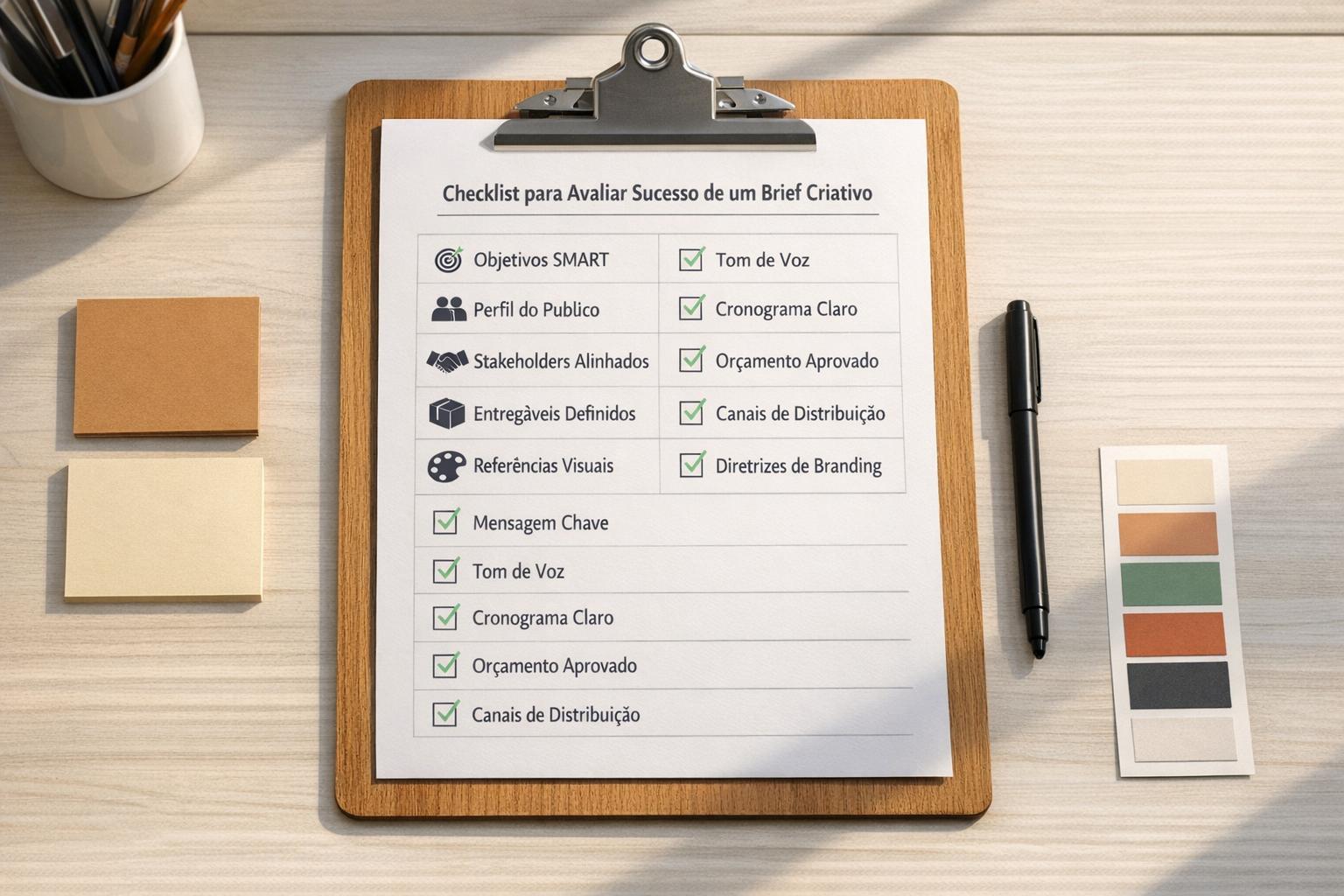
A well-structured creative brief is the foundation for any successful project. Yet many fail to align business objectives with practical execution — leading to rework and wasted resources. To avoid this, here’s what matters most:
- Define clear, measurable objectives (SMART).
- Understand your target audience with detailed demographic and psychographic data.
- Identify stakeholders and their roles in the process.
- Specify project scope, including deliverables and constraints.
- Provide visual references and strategic context to guide the team.
- Use a practical checklist to evaluate brief quality.
The key is treating the brief as a living document — adjusting it whenever necessary to maintain alignment among everyone involved. Following these practices reduces errors, improves communication, and ensures the project achieves its goals.
This checklist provides a practical guide for evaluating the quality of a creative brief. Each point is essential for ensuring that business strategy is aligned with creative execution — helping identify gaps and confirming the document fulfills its purpose.
1. Alignment with Project Objectives
Essential question: Does the brief translate business objectives into clear creative direction?
A brief should function as a “compass and map” — guiding the team toward a common goal from the start. It needs to transform business goals into concrete creative instructions.
“Badly run brands try to do everything, all the time, to everyone. Better brands are selective and selfish. Their strategies revolve as much around what they will not do, as what they intend to achieve.”
How to confirm:
- Ensure the brief defines the project’s “why” — the problem to solve and its connection to a measurable business objective. It should also categorize briefing depth according to campaign type (e.g., highly creative projects as Tier 1 versus simple adjustments as Tier 3).
- Use the brief in every project meeting to verify that decisions remain aligned with primary objectives.
With objectives established, the next step is detailing the target audience.
2. Target Audience Description
Essential question: Does the brief accurately describe who the audience is to guide creative development?
The audience should be defined based on demographic data (such as age, gender, location, profession) and psychographic characteristics (habits, interests, values, lifestyle). Notably, 82% of agencies say client briefs rarely include a clear audience insight, while 73% of clients believe they provide this information.
How to confirm:
- Create 1 to 3 representative personas to help the creative team visualize the target audience.
- Identify the platforms the audience uses (e.g., TikTok for younger audiences, Facebook for older ones).
- Specify how the brand should be perceived (e.g., “premium,” “accessible,” “bold”).
- Test clarity by comparing how the project would be adjusted for different groups — for example, young singles versus parents.
With the audience defined, it’s time to establish clear goals.
3. SMART Objectives
Essential question: Are the objectives Specific, Measurable, Achievable, Relevant, and Time-bound?
Objectives must go beyond vague or emotion-based statements. They need to be tied to numbers and be measurable.
“Goals must be measurable. Still it somehow is often the hardest part when it comes to creative. These can sometimes be lofty, or emotionally based. But try to stick figures on as much as possible.”
How to confirm:
- Assign numerical values wherever possible.
- Instead of “increase brand awareness,” specify something like “increase awareness by 25% among 25–34 year olds by June 30, 2026.”
- Include metrics such as lead generation, brand recognition, or conversion rates.
- Review these metrics at project checkpoints to ensure they remain aligned with objectives.
Now, clearly identify stakeholders.
4. Stakeholder Identification
Essential question: Are all decision-makers and key players clearly identified in the project?
Anyone with authority to approve or evaluate work should be involved in creating or reviewing the brief. Without this clarity, 75% of agencies and 55% of clients report frequent brief changes after the project has started.
How to confirm:
- List all stakeholders with their names, roles, and responsibilities.
- Identify who has final approval authority, who provides feedback at each stage, and who only needs to be kept informed.
With stakeholders defined, move to project scope.
5. Project Scope and Deliverables
Essential question: Does the brief clearly define the project boundaries and expected deliverables?
A clear scope definition helps prevent “scope creep” — when the project expands beyond what was agreed. Data shows that 99% of agencies and 98% of clients agree that poorly prepared briefs and undefined objectives waste resources.
How to confirm:
- List deliverables with details such as format, dimensions, quantity (e.g., “3 Instagram posts 1080x1080px, 1 Facebook video 16:9”) and the number of planned revisions.
- Specify what is out of scope to avoid misunderstandings.
- Treat the brief as a living document and update it as technical or creative details are clarified.
With scope defined, gather visual references to guide creative work.
6. Visual and Strategic References
Essential question: Does the brief include supporting materials that guide creative direction?
Visual and strategic references help the creative team understand the desired style and tone — minimizing unnecessary revisions and miscommunication.
How to confirm:
- Attach mood boards, examples of previous work, brand guidelines (visual identity, colors, typography), and relevant market data.
- Include examples of what to avoid — showing what doesn’t work can be as useful as highlighting what does.
Finally, ensure brand context is well defined.
7. Brand and Market Context
Essential question: Does the brief provide enough information about brand identity, values, and positioning?
Understanding brand context ensures creative work reflects its essence and message.
How to confirm:
- Describe the brand’s personality with 3 to 5 adjectives (e.g., “innovative, accessible, sustainable”).
- Explain the brand’s market positioning and its key differentiators.
- Define the appropriate tone of voice — for example, a younger audience may prefer a casual tone, while a corporate audience may require a more formal approach.
How to Use This Checklist
This checklist is a practical tool for ensuring project decisions remain aligned with the objectives defined in the brief. It should be used at every project meeting or checkpoint — helping monitor progress and work consistency. It also includes a scoring system to evaluate brief quality.
For essential items — such as “Stakeholder Identification” or “Budget and Resources” — use binary scoring: assign 1 if the item is present and 0 if absent. For more complex elements — such as “SMART Objectives” or “Visual References” — use a scale from 0 to 3:
- 0: Not present.
- 1: Present, but vague.
- 2: Partially developed.
- 3: Complete.
After scoring, bring together the key leads — such as the account director, creative director, and art director — for a collaborative evaluation. This teamwork ensures the brief serves as a clear directional tool rather than something that limits creativity. This approach also helps prevent divergent interpretations and ensures everyone is aligned on objectives.
Finally, calculate a success percentage: (points achieved / total points) × 100. For example, if the checklist has 12 items with a maximum of 3 points each (36 total points) and the brief scores 28 points, the percentage is approximately 78%.
To keep the brief relevant throughout the project, treat it as a living document. This allows adjustments whenever new challenges or important information arise. Document and communicate all changes so the team stays aligned with the defined objectives.
Common Mistakes and How to Avoid Them
Ensuring a well-structured brief is essential — but it’s not enough on its own. It’s equally important to stay alert to frequent mistakes that can affect project success.
One of the most common problems is the absence of measurable objectives. Many teams opt for generic goals — like “increase brand awareness” — instead of establishing clear, specific metrics. This makes it difficult to evaluate results and demonstrate success. The solution? Define concrete, quantifiable goals. Instead of “increase brand awareness,” commit to something like “increase unprompted brand recognition by 25% in the next six months.” SMART objectives — mentioned throughout this checklist — are essential for measuring progress effectively.
Another recurring mistake is creating the brief in isolation. Often, only one person — typically an account manager — develops the document without consulting creative or art directors. As Emilee Dover, Art Director, puts it:
“The Creative Brief is written for the creative team. It is intended to be a tool, not a weapon.”
To avoid this, involve the entire team from the start. Collaboration across different perspectives promotes stronger alignment and facilitates more cohesive work.
Lack of brand context is another significant obstacle. Without clear information about how the audience currently perceives the brand and what change is desired, the team is left without direction. A good brief should include details about key competitors and highlight what makes the brand special — helping the team find a unique, relevant positioning. Also avoid excessive technical jargon, which can confuse rather than clarify.
Finally, some treat the brief as a mere bureaucratic formality — filling it with technical terms that hold no strategic value. On this, Mark Ritson, Marketing Professor, warns:
“We’ve all seen super-complex strategies that can’t fit into less than fifty pages or two-hour presentations. Each is the result of under-thinking and culminates in a pointless strategy that no one can understand or execute.”
The key is keeping the brief clear, direct, and functional. It should serve as a practical guide for every stage and meeting of the project.
Scoring Template
To complement the checklist, here’s a practical tool that helps measure the effectiveness of a creative brief objectively.
This table transforms the qualitative evaluation of the brief into weighted numerical values — making it easier to identify weak points and communicate with the team. Each criterion is assigned a weight based on its relevance to project success.
| Checklist Category | Evaluation Criteria | Weight (1-5) | Score (Yes=1 / No=0) | Weighted Total |
|---|---|---|---|---|
| Project Objectives | Are the objectives SMART (Specific, Measurable, Achievable, Relevant, Time-bound)? | 5 | ||
| Target Audience | Does it include demographic, psychographic, and pain point data? | 5 | ||
| Strategic Context | Does it explain the “why” and the competitive landscape? | 4 | ||
| Deliverables | Are technical specifications (dimensions, format, resolution) detailed? | 3 | ||
| Budget and Timeline | Are milestones and resource constraints clearly defined? | 3 | ||
| Brand Guidelines | Are “sacred cows” (logos, colors, tone) identified? | 2 | ||
| Approval Process | Is the final decision-maker identified? | 2 | ||
| TOTALS | 24 | Sum / 24 = % |
This table can be adjusted based on project needs. For example, in a technical web development project, “Deliverables” and technical specifications may carry more weight. In emotional branding campaigns, “Target Audience” and “Strategic Context” take priority. Bruno Gralpois, Co-founder of Agency Mania Solutions, reinforces the importance of this alignment:
“A creative brief is an opportunity for brands to outline their ambition and ensure there is alignment between the marketing team and the agency on what the project is and what it needs to accomplish.”
If the brief scores below 70%, it’s essential to revise it to avoid rework and wasted resources. Studies show that 85% of high-performing campaigns have specific, measurable objectives — justifying the high weight assigned to that category.
Remember: this table isn’t a mere formality — it’s an alignment tool that protects both the project budget and timeline. Use it to monitor and adjust briefs throughout the process.
Conclusion
A well-crafted brief can determine the success of a project, while a poorly structured one wastes time and resources. As Deb Giampoli, Co-founder of Stone Soup Consultants, puts it:
“The creative brief is the foundation to any creative project’s success.”
This checklist transforms that foundation into a clear, practical strategic approach.
It’s important to remember that the brief isn’t just a fixed document — it’s a living tool that guides every stage of the project. Bruno Gralpois, Co-founder of Agency Mania Solutions, underlines:
“The process enabled by the brief is probably more important than the brief itself.”
Collaboration during brief review is essential for creating alignment and trust among everyone involved — as demonstrated throughout this checklist.
To ensure an effective collaborative approach, it’s crucial to include key decision-makers from the start. This prevents late-stage revisions or unexpected vetoes — protecting the budget and ensuring brand consistency.
And never forget: a concise, direct brief is always more effective than long, impractical documents. Define clear, measurable metrics — like the SMART objectives mentioned throughout — and use the brief as a compass to guide the team toward concrete, achievable results.
FAQs
How do you ensure a creative brief is aligned with project objectives?
For a creative brief to fulfill its purpose, it needs to be clear, detailed, and the result of a collaborative effort. It’s essential that the client, creative director, and team are on the same page regarding the project’s mission, objectives, and expectations.
An effective brief serves as a strategic guide — helping the team stay focused on intended outcomes, avoid misunderstandings, and identify potential challenges before they become problems. This ensures that business objectives and creative vision remain aligned — contributing to a successful outcome.
Why is it essential to define the target audience in a creative brief?
Accurately defining the target audience in a creative brief is fundamental to ensuring the message reaches its intended recipients effectively and relevantly. This step serves as a guide for the entire project strategy — enabling the development of solutions that genuinely connect with the right people.
When you understand your target audience well, you avoid wasting resources and unnecessary rework — increasing efficiency and improving the chances of achieving the established objectives. This clarity translates into more impactful campaigns with a higher return on investment.
How can SMART objectives make a creative brief more effective?
SMART objectives make a creative brief more effective by establishing goals that are clear, measurable, realistic, relevant, and time-bound. With this framework, everyone involved understands exactly what’s expected — creating solid alignment between the team and the client.
Another benefit is that SMART objectives allow progress to be tracked in a structured way. This makes it easier to implement strategic adjustments along the way — ensuring the project stays on track and achieves the expected results.
Related Blog Posts
Let’s Get Started
Tell us about your project and we’ll get back to you within 24 hours